Jema
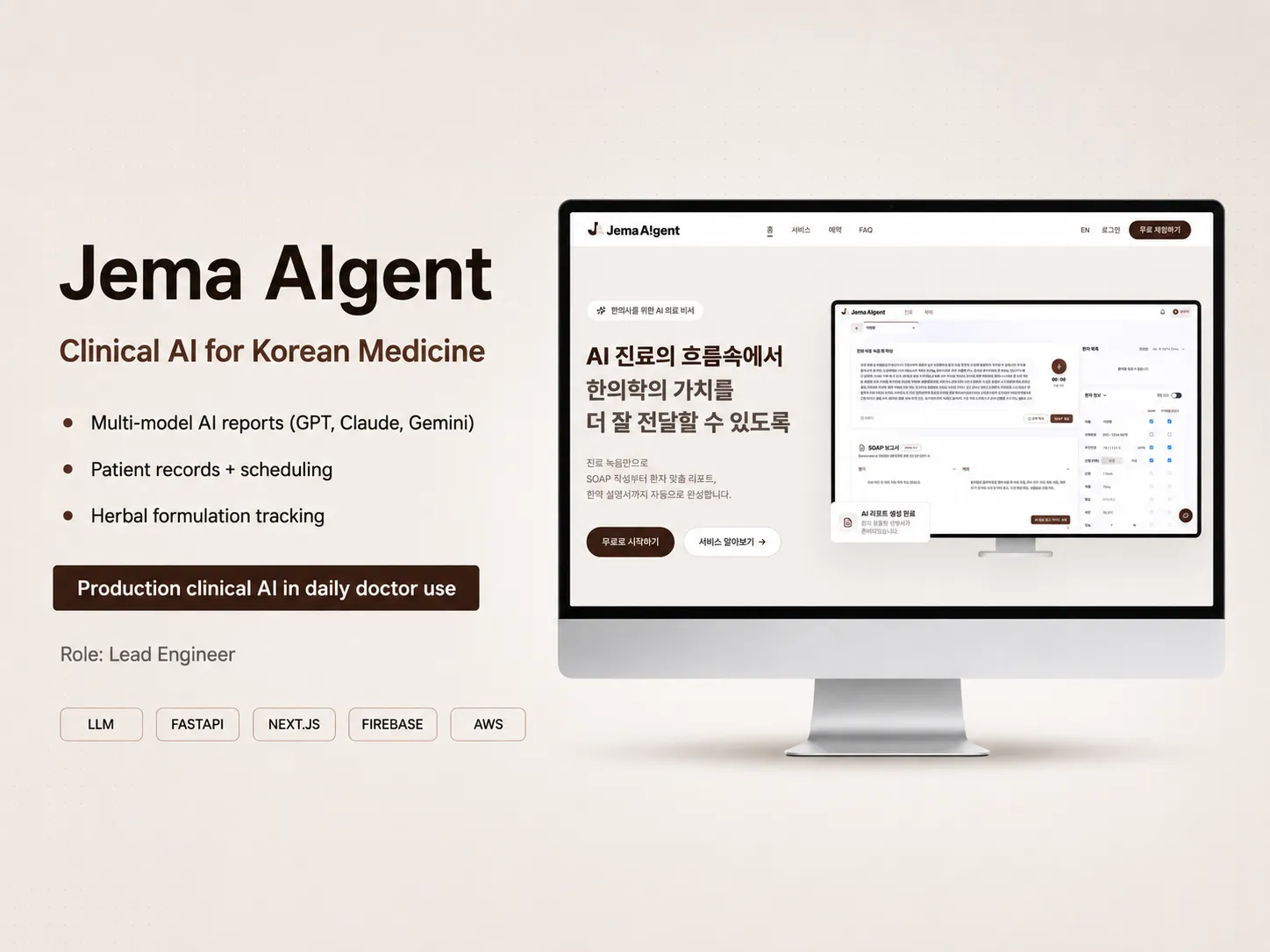
A clinical AI platform for Korean medicine, used by doctors in Korea.
- Lead AI engineer, end to end
- June 2025 to present
- React, Next.js, Python, FastAPI, PostgreSQL, Supabase, Multi-model LLM routing, AWS, Docker
The problem
The founders had a clear vision for a clinical AI platform for Korean medicine, the traditional and herbal side of care, but no engineering team to build it. They needed a real product doctors could use in a live clinic, not a demo that falls over the first time a report has to generate under pressure.
That meant building the whole thing end to end: the web app doctors work in, the backend and data model behind it, and the AI itself. And it had to work in Korean, for real clinical workflows, from day one.
What I built
Jema is a clinical AI platform used by doctors in Korea. It generates clinical reports with AI, keeps patient records, handles scheduling, tracks herbal formulations, and supports doctor verification and multi-clinic use, in a multilingual product built for Korean-medicine practice.
I built and own it end to end: the React and Next.js front end, a Python and FastAPI backend, the PostgreSQL data layer on Supabase, the multi-model AI, and the infrastructure it runs on. It is my flagship build, and it is live.
The hard parts
Reports that survive a provider outage
Report generation runs across multiple models, GPT, Claude, and Gemini, behind an automatic fallback and cost-aware routing layer I built. If one provider is down, slow, or expensive, a report still generates from another. A doctor mid-consult never sees the plumbing; they just get their report.
One patient record everywhere
The products in the suite share a unified patient index, so a patient is one record everywhere rather than a copy per app.
Single sign-on across the suite
SSO lets a doctor move between the products without re-verifying, while access stays controlled.
Patient data
Encrypted patient-data handling with access controls was built in from the start rather than bolted on later.
EMR integration (in progress)
I am architecting the integration layer that will let Jema sit alongside the systems clinics already run. It is in progress, not shipped.
Where it is now
Jema is live and used by doctors in Korea. It is the kind of product where reliability is not a nice-to-have: if the AI or the data layer is flaky, real clinical work stops. That is the bar I build to.